Undersea Solitaire Tripeaks
- 4.6
- Rating
- 1.00M
- Installs
- Free
- Price
 Analysis by App-foxy
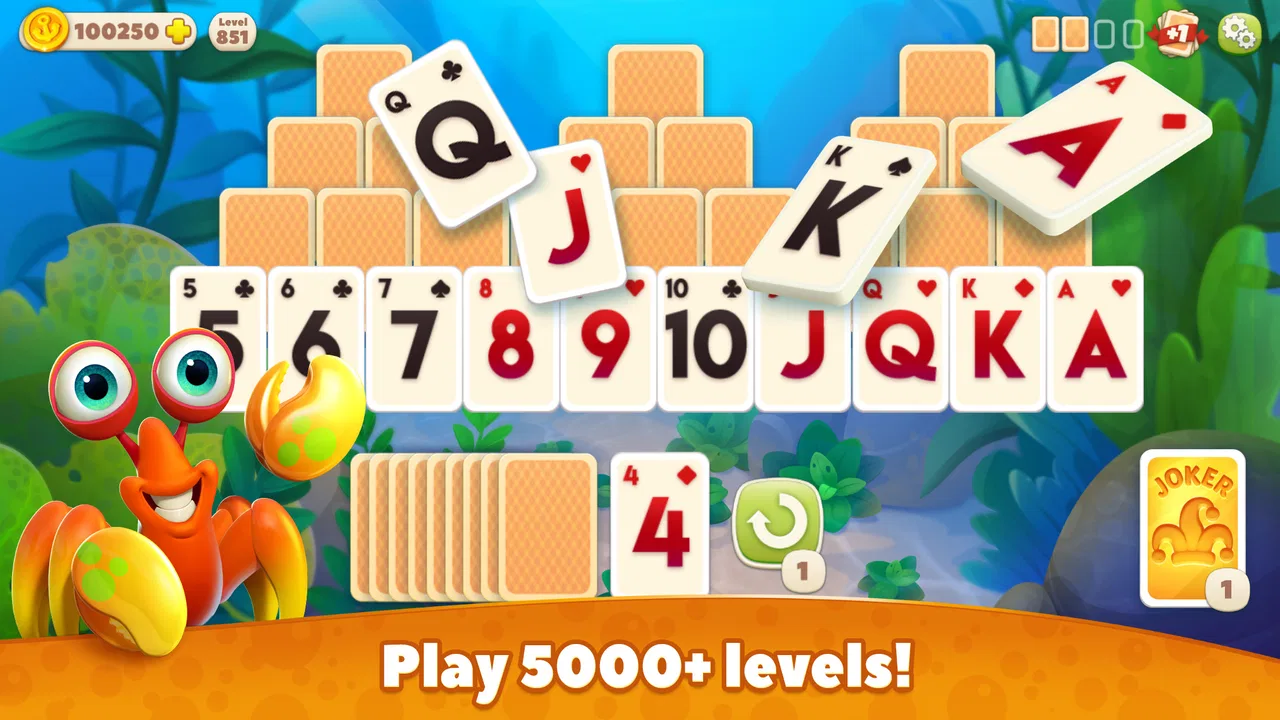
I approached Undersea Solitaire Tripeaks as a relaxing card game first and an underwater adventure second. Its central idea is easy to understand: clear cards from a TriPeaks layout by choosing cards that sit one rank above or below the card in your hand. The sea setting gives that familiar solitaire formula more personality, while the short rounds make it suitable for a quick break rather than a long, uninterrupted session.
After spending time with it, I think the game works best for people who enjoy simple rules, gradual progress, and a little visual atmosphere around their card play. It is not trying to replace a deep strategy game or a traditional casino-style solitaire app. Instead, it adds a sense of movement and discovery to a format many players already know. That combination is appealing, although the progression layer also creates the main questions about patience, spending, and how much pressure a player feels during a difficult run.
How the underwater TriPeaks format feels in everyday play
The basic loop is approachable even if you have never played TriPeaks before. You look at the exposed cards, choose a legal move, and try to build a sequence without breaking it. A good run can feel satisfying because each choice opens another part of the layout. When the available moves disappear, however, the outcome can depend heavily on the cards still hidden from view. That mixture of planning and luck is central to the experience.
You May Also Like

 Blood Strike: 2.5 Anniversary
Blood Strike’s Loadouts Turn Every Drop Into a Tactical Gamble
A close look at Blood Strike’s custom loadouts: how fast access to signature weapons reshapes its battle royale rhythm, rewards preparation, and narrows the gap between fights.

 Pandora - Music & Podcasts
Pandora’s Music Is Easy to Start, but Harder to Recover
Pandora’s strength is its low-effort path from a seed to a station. Its weak spot is how much confidence it asks you to place in connection, setup, and quiet recovery.

 8 Ball Pool
 Is Built on Rivalries, Rematches, and Routine
A close look at the rivalries, rematches, shared routines, and unanswered safety questions that turn a quick pool match into a persistent mobile community.

 Samsung Music
’s Quiet Strength Is Playing What You Already Own
Its reach comes less from spectacle than from dependable access to a personal library. That simplicity is both the app’s strongest retention engine and its ceiling.

 AccuWeather: Weather Radar
AccuWeather Review: A Quick, Clear Forecast for Everyday Decisions
For everyday plans, the best forecast is the one you can understand quickly. AccuWeather makes rain timing, radar, and local conditions easy to act on, with a few trade-offs.

 Hill Climb Racing
Why Hill Climb Racing Still Turns Crashes Into One More Run
A tiny car, a bumpy hill and one more upgrade: Hill Climb Racing keeps resurfacing because its simple chaos makes every near-miss feel personal.
More From Our News Desk



I found the game particularly comfortable in situations where I wanted something active but not demanding. A short session during a commute, while waiting for an appointment, or before going to bed fits the format naturally. You can focus on the board for a few minutes, make meaningful decisions, and stop without needing to remember a complicated story or control scheme.
The underwater presentation matters more than it might seem. A plain solitaire game can become visually repetitive very quickly, but the ocean theme gives the surrounding progression a reason to exist. It makes each completed stretch feel connected to a broader journey instead of being just another isolated deal. I would not call the setting a substitute for deep content, but it gives the card mechanic a clearer identity.
There is also a useful mental distinction between a safe move and an ambitious move. If several cards are available, taking the option that preserves a longer sequence is often more valuable than immediately choosing the most obvious card. I recommend checking the whole exposed layout before tapping. That small habit prevents the common mistake of spending a useful rank too early and leaving a better continuation inaccessible.
Another practical tip is to avoid treating every available card as equally urgent. In TriPeaks, the order in which you uncover cards can change the entire shape of the round. I usually look for moves that reveal covered cards or create two possible follow-ups. This does not remove the luck factor, but it gives the player more control over how much information becomes available before the sequence ends.
Progression adds motivation, but also changes the mood
The adventure framing gives repeated rounds a purpose. Instead of playing only for a score that disappears when the deal ends, you have a continuing reason to return. That is useful for players who need a gentle goal to keep a casual game interesting. It also makes failure feel more noticeable, because a difficult board can interrupt the feeling that the journey is moving forward.
That tension is worth understanding before installing it. If you want completely consequence-free solitaire, a basic offline card app may feel calmer. Here, the surrounding progression can make a win more rewarding, but it can also make a loss more frustrating than it would be in a traditional solitaire game. The choice depends on whether you enjoy a light sense of pressure or prefer every round to stand alone.
My strongest advice is to treat each session as a small puzzle rather than as a race. Rushing encourages impulsive taps, especially when a sequence appears to be going well. Pausing to identify which exposed card gives you the most future options is more useful than chasing a long chain for its own sake. This is one of the few ways to make your decisions feel consistently better even when the deal itself is unfavorable.
The game is free to download, and Plarium Global Ltd is the developer behind it. Purchases are available inside the game, ranging from $0.99 to $99.99 per item. That is important context for anyone who prefers games with no spending layer at all. The presence of those purchase options does not by itself prove that progress requires payment, so I would not describe the game as automatically unfair. It does mean that players should decide in advance whether they are comfortable with optional spending appearing around a progression-based card experience.
What spending means for a cautious player
I would approach the purchase system with a simple personal rule: enjoy the free loop first and do not buy anything merely because a difficult board has created impatience. Card games are especially good at producing “one more attempt” feelings, because a near-success can make the next round seem certain even when the underlying deal still contains luck. Waiting before spending helps separate genuine enjoyment from frustration.
Parents should also remember that the game carries an Everyone age rating, while in-app purchases remain available. That combination makes device-level purchase controls sensible if children use the phone or tablet. The rating describes the intended content audience; it should not be treated as a promise that a child will never encounter a purchase prompt or a progression decision connected to spending.
I also would not assume that paying automatically turns the game into a skill contest. Purchases may make some parts of the experience more convenient, but convenience and strategic ability are different things. The core TriPeaks decisions still involve reading the layout, managing the sequence, and accepting that some deals will not cooperate. Players looking for a purely skill-based competition should be cautious about expecting that from this format.
Fairness and the question of competition
For me, the game is easier to judge as a personal puzzle adventure than as a competitive card title. The appeal comes from improving your choices, clearing layouts, and continuing through the underwater setting. That makes spending less relevant to the enjoyment of someone who plays privately and is willing to move slowly.
The fairness question becomes more complicated whenever a game combines random card layouts, progression pressure, and optional purchases. A player may feel that a purchase helps them continue, but that does not necessarily mean the next board becomes strategically equal to another player’s board. Randomness can affect outcomes before spending enters the picture. I would therefore avoid using purchase availability as evidence that the game is either fair or unfair in every situation.
If your main goal is to compare performance with friends under identical conditions, a conventional solitaire app with transparent scoring rules may be a better fit. A more stripped-down alternative can make the result feel easier to interpret because there is less surrounding progression competing for attention. Undersea Solitaire Tripeaks is more attractive when you want a themed solo journey, not when you need a clean tournament environment.
That distinction also helps explain why the game can satisfy one player and annoy another. Someone who enjoys collecting small wins and returning to a persistent setting may see the extra layer as motivation. Someone who wants to shuffle, play, and leave without any sense of unfinished progress may find the same layer distracting. Neither reaction is wrong; they reflect different expectations from a card game.
Technical fit and long-term expectations
The game supports devices running Android 6.0 or later, which makes it accessible to many older Android phones and tablets. Its current version is 1.42.8, so anyone installing it should still check how it behaves on their particular device rather than assuming that an older handset will feel identical to a newer one. Card games usually have modest control demands, but smoothness, loading, and battery behavior can vary between devices.
It was released on April 1, 2020, and has since built a substantial audience, with more than one million installs. Its average rating is 4.6 from roughly forty-six thousand ratings, alongside about six thousand one hundred written reviews. Those figures suggest that the overall concept has connected with many players, but they should be read as a broad signal rather than a guarantee that the progression style will suit you personally.
The rating is useful because it indicates that the game is not an obscure experiment with no established audience. Still, popularity cannot answer the questions that matter most to a cautious player: whether the pace feels comfortable, whether optional purchases are easy to ignore, and whether the underwater theme remains interesting after the novelty fades. Those are personal judgments, and I would base the decision more on your tolerance for progression pressure than on the rating alone.
One unknown I would keep in mind is how the balance between free play and purchases feels over a long period. The available purchase range tells us that spending options exist, but it does not establish how often a player will encounter them, how necessary they are, or whether a careful player can comfortably continue without paying. I would not fill those gaps with assumptions. The sensible approach is to play without spending at first and observe whether the normal rhythm feels enjoyable on its own.
The same caution applies to long-term variety. The TriPeaks rule set is naturally repeatable, but repetition is only enjoyable when the surrounding goals continue to feel meaningful. Some players can play the same basic mechanic for months because they like refining their decisions. Others need new modes, stronger narrative, or more dramatic changes in challenge. If you belong to the second group, the game may be best as a companion title rather than your only card game.
Who should play it, and who should skip it
I would recommend it to someone who wants a friendly, visually themed solitaire experience with short sessions and a continuing sense of direction. It is a good match for players who already understand the pleasure of turning a few available cards into a longer chain, but who want more atmosphere than a plain deck and background can provide.
It is also suitable for people who enjoy making small tactical decisions without learning a large ruleset. The most rewarding moments come from looking ahead, preserving useful ranks, and revealing cards in an order that keeps options open. You do not need expert card-game knowledge, but you do benefit from patience and from resisting the urge to tap the first legal move.
I would suggest skipping it if you dislike luck affecting puzzle outcomes. Even careful play cannot guarantee that every layout will cooperate. I would also choose a simpler solitaire app if you want no progression pressure, no purchase prompts, or no reason to continue beyond the current deal. Players seeking head-to-head competition should likewise look elsewhere unless they are comfortable treating this as a solo game first.
For families, the Everyone rating is reassuring regarding the intended audience, but I would still set purchase protections before handing over a device. For older Android users, the minimum operating-system requirement is worth checking before installation. For anyone managing limited storage or battery, I would test a few sessions rather than relying on assumptions about how a themed game will behave on a particular phone.
My trust verdict after weighing the trade-offs
My overall view is positive but deliberately measured. Undersea Solitaire Tripeaks has a clear identity, an easy entry point, and enough progression structure to make familiar card play feel like part of a larger underwater trip. I like that it can fit naturally into small gaps in the day, and I appreciate that better play comes from planning the order of moves rather than simply tapping whatever is available.
At the same time, I would not recommend approaching it as a completely neutral solitaire utility. The progression layer changes how losses feel, and the presence of purchases means that a player should decide on spending boundaries before becoming invested in a difficult run. The game may be perfectly enjoyable without paying, but the responsible conclusion is to test that experience yourself instead of assuming either extreme.
With its free entry, Everyone rating, broad Android compatibility, and strong player reception, it is an easy game to try. My recommendation is strongest for casual solo players who want themed TriPeaks rounds and are comfortable treating progress as a bonus rather than an obligation. The fairest way to enjoy it is to judge each board by the quality of your decisions, not by how quickly you can push forward or how much you are willing to spend.
In short, I would keep it installed for relaxed card sessions, especially when I want something more distinctive than standard solitaire. I would not use it as my choice for strict competitive fairness or completely pressure-free play. If that trade-off matches what you want from an underwater card adventure, it is worth trying; if you mainly want a clean deck, a shuffle, and nothing else around it, a conventional solitaire alternative will probably serve you better.
FAQs for Undersea Solitaire Tripeaks
01What is Undersea Solitaire Tripeaks?
Undersea Solitaire Tripeaks is a casual solitaire game that combines the classic TriPeaks card format with an underwater adventure theme. You clear cards from the board by selecting cards one rank higher or lower than the current card, while progressing through ocean-inspired levels. The game is designed for short sessions and includes colorful visuals, simple controls, and gradually more challenging layouts.
02How do you play Undersea Solitaire Tripeaks?
The main objective is to remove as many cards as possible from the tableau by matching cards that are one value above or below the face-up card in the discard area. If no suitable move is available, you draw another card from the deck. Planning ahead is important because limited cards, blocked layouts, special obstacles, and level objectives can make later stages more difficult.
03Is Undersea Solitaire Tripeaks free to download and play?
Undersea Solitaire Tripeaks is generally available as a free download, allowing players to access the basic game without paying upfront. However, free-to-play features may include optional in-app purchases, advertisements, or systems that limit certain resources such as lives, boosters, or extra moves. Before downloading, check the store listing and your device settings for current pricing and purchase information.
04Can Undersea Solitaire Tripeaks be played offline?
Some solitaire levels may remain playable without a continuous internet connection, which can make the game convenient for travel or areas with weak signal. Nevertheless, online access may be required for advertisements, rewards, cloud synchronization, updates, events, or in-app purchases. Offline availability can also vary between versions and devices, so it is best to test the game after installation rather than assume every feature works without internet.
05Is Undersea Solitaire Tripeaks suitable for all ages?
The game uses straightforward card-matching mechanics and does not normally require advanced gaming experience, making it approachable for many casual players. Parents should still review the age rating, advertising content, and in-app purchase settings before allowing children to play. Because progression may include optional purchases or timed resources, enabling purchase restrictions can help prevent accidental transactions on shared Android or iOS devices.
Pros
- Relaxing underwater theme with colorful visuals and gentle sound effects.
- TriPeaks rules are easy to learn
- even for casual card game players.
- Short levels make it convenient for quick gaming sessions.
- Progression and level goals provide a clear reason to keep playing.
- Playable offline
- making it useful during travel or without reliable internet.
Cons
- Random card layouts can occasionally make levels feel dependent on luck.
- Some stages may require boosters or repeated attempts to complete.
- Frequent ads can interrupt the flow for players on the free version.
- The core TriPeaks gameplay may feel repetitive over longer sessions.
- Extra purchases may be needed by players seeking faster progression.

Undersea Solitaire Tripeaks
Gallery